


Villa di Monaciano
Villa di Monaciano is not particularly old in comparison with many Tuscan villas. Records of its existence date back to the 18 C, and its current appearance results from a restoration of the whole estate carried out between about 1870 and 1885, when it was the property of Alessandro Pucci Sansedoni, a Siennese nobleman living in Florence. In keeping with the general spirit of stylistic renewal typical of Florence at that time, Sansedoni constructed a quite innovative villa and garden complex, relocating the access road, demolishing the old walls that once surrounded the garden and creating a romantic park in the style that was gradually becoming popular in Florence under the guidance of architect Poggi and of the Pucci family of gardeners.
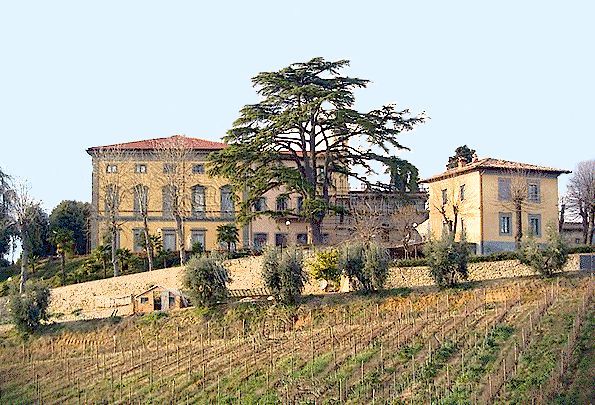
Villa di Monaciano
The architect of the villa is unknown. In terms of the architectural culture it expresses, the villa seems quite far removed from the Siennese tradition, having more in common with Florentine architecture of the second half of the 19 C. The building has three floors and the façade is divided into three parts by pilasters. Three entrance portals open up in the central part, which is rusticated on the ground floor level. A double string-course draws attention to the piano nobile, which has at its centre three arched french doors flanked on either side by two windows topped by classical tympana. All these openings are framed in pietra serena.
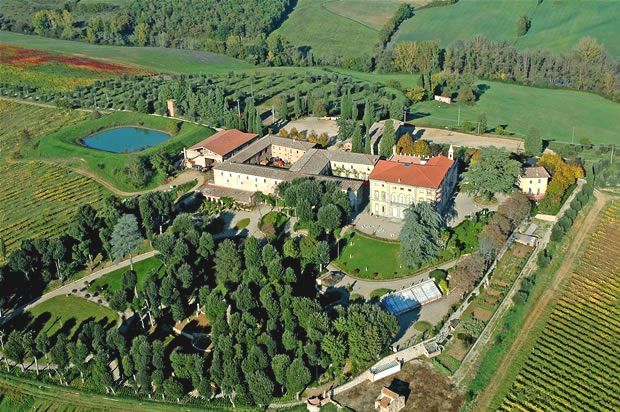
The grounds of Villa Monaciano
The park of Villa Monaciano occupies approximately three hectares, sloping in front of the villa and extending out both to the south and to the west of the villa, and closed off to the south by a boundary wall. The park is divided into more or less two parts: the first is a flower garden, to the south and on the higher ground; the second, lower down, is a romantic park comprising extensive wooded areas crossed by winding paths along which unexpected views open up, with the villa providing the backdrop to the panorama. The layout here is in true "English style", with an alternation of full, leafy woods and large, open clearings. Just a few species of trees, mostly evergreens, are planted in the park: mainly holm-oaks, but also a large cedar of Lebanon, and some horse chestnuts, oaks and also palm trees. One of the features that characterises the garden is the use of water. There are various fountains, water effects on some of the structures and most especially, a nymphaeum. This latter feature, known also as the Laghetto della Venere, or "Lake of Venus", has two spongestone grottoes underneath and a rocky section in the centre with a sculpture of a "bather", from whose feet water issues forth.
The park also contains a large brick and cast-iron aviary, a limonaia with an extensive collection of large citrus trees, and an antique hothouse with a heating system that is still fully functioning. The hothouse dates from 1881 or earlier and occupies a prominent position in the garden, which probably explains why it survived a succession of renovations. Pucci Sansedoni was an honorary member of the Royal Tuscan Horticultural Society and the hothouse is evidence of his great interest in botany. It is the only large greenhouse of its kind in the area. Inside, exotic plants, including a collection of begonias, ferns, orchids and anthurium, are still grown.
The park also contains a large brick and cast-iron aviary, a limonaia with an extensive collection of large citrus trees, and an antique hothouse with a heating system that is still fully functioning. The hothouse dates from 1881 or earlier and occupies a prominent position in the garden, which probably explains why it survived a succession of renovations. Pucci Sansedoni was an honorary member of the Royal Tuscan Horticultural Society and the hothouse is evidence of his great interest in botany. It is the only large greenhouse of its kind in the area. Inside, exotic plants, including a collection of begonias, ferns, orchids and anthurium, are still grown.
 |
|
|
|
|
|
|
|
|
|
|
|
|
|
|
|
|
|
|
|
|
|
|